
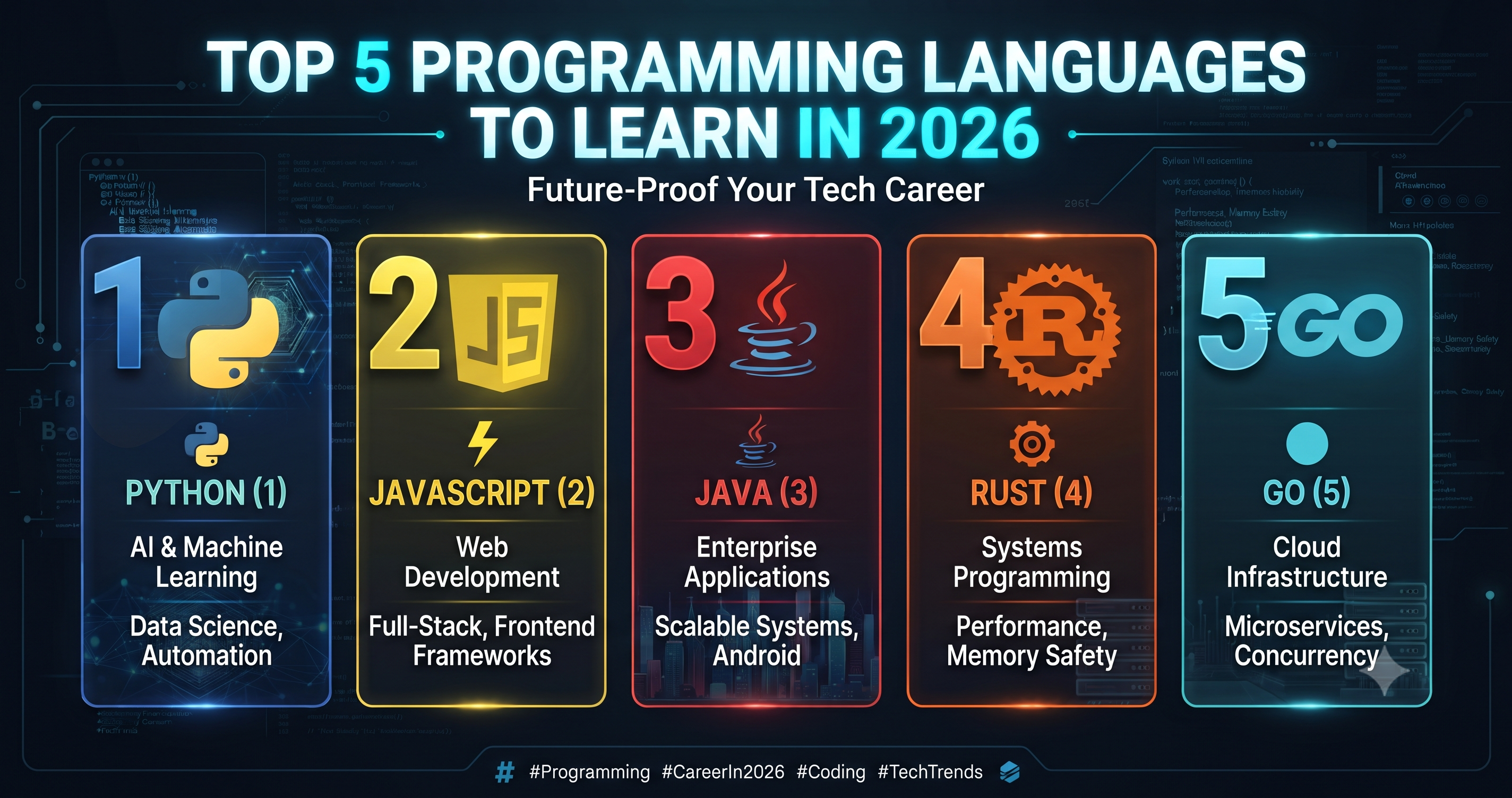
The technology landscape moves at a breathtaking pace. What was cutting-edge a couple of years ago can quickly become legacy tech, replaced by more efficient, secure, and intelligent alternatives. For developers, students, and tech professionals looking to stay competitive, choosing the right programming language to learn or master is one of the most impactful career decisions you can make.
As we navigate 2026, the industry is heavily influenced by the maturity of artificial intelligence, cloud-native scalability, high-performance computing, and cross-platform development. Whether you are aiming to break into tech, pivot your career, or level up your engineering skills, here are the top 5 programming languages you should learn in 2026.
1. Python: The Undisputed King of AI and Data Science
If there is one language that has cemented its dominance over the decade, it is Python. Known for its clean syntax, readability, and vast ecosystem, Python has evolved from a beginner-friendly scripting language into the absolute backbone of modern artificial intelligence, machine learning, and data engineering.
Why Python Matters in 2026:
AI and LLM Integration: With artificial intelligence deeply embedded into almost every software product, Python remains the primary language for building, fine-tuning, and deploying machine learning models and Large Language Models (LLMs). Frameworks like PyTorch, TensorFlow, and LangChain rely heavily on Python.
Automation and Scripting: Python’s versatility extends far beyond data science. It remains the top choice for backend web development (using frameworks like FastAPI and Django), cloud automation, and cybersecurity scripting.
Massive Community and Ecosystem: If you encounter a bug or need a specific package for a project, chances are someone has already solved it. The Python Package Index (PyPI) hosts hundreds of thousands of libraries ready to accelerate development.
Who should learn it: Absolute beginners looking for a smooth entry into coding, data scientists, backend developers, and anyone eager to build AI-driven applications.
2. Rust: The Gold Standard for System Safety and Performance
For years, C and C++ were the undisputed rulers of systems programming, game development, and high-performance applications. However, their vulnerability to memory management bugs has made them a liability in modern secure software. Enter Rust, a language engineered specifically for safety, concurrency, and raw performance.
Why Rust Matters in 2026:
Memory Safety Without Garbage Collection: Rust’s unique ownership model guarantees memory safety and thread safety at compile time, eliminating entire classes of bugs (like null pointer dereferences and buffer overflows) without needing a heavy garbage collector.
Adoption by Tech Giants: Major tech institutions, operating system vendors, and cloud providers—including Linux, Microsoft, Amazon Web Services (AWS), and Google—are actively rewriting critical infrastructure components in Rust.
High Performance: Rust offers execution speeds comparable to C and C++, making it ideal for game engines, blockchain infrastructure, embedded systems, and high-throughput web servers.
Who should learn it: Developers looking to transition into systems programming, backend engineers wanting to build ultra-fast microservices, and programmers interested in low-level architecture.
3. TypeScript: The Backbone of Modern Web and Full-Stack Development
JavaScript has powered the interactive web for decades, but as web applications grew into massive, complex enterprise systems, vanilla JavaScript's dynamic typing became a bottleneck. TypeScript, a strongly typed superset of JavaScript developed by Microsoft, has transformed web development by bringing type safety and robust tooling to the browser and server.
Why TypeScript Matters in 2026:
Enterprise Web Dominance: TypeScript is now the default language for modern frontend frameworks like React, Next.js, Angular, and Vue. It is also heavily used on the backend via Node.js and Deno.
Catching Errors Early: By introducing static typing, TypeScript allows developers to catch errors during development rather than in production, significantly improving code maintainability.
Enhanced Developer Experience: Modern IDEs provide superior autocompletion, refactoring tools, and code navigation for TypeScript, making large codebases much easier to manage.
Who should learn it: Frontend developers, full-stack engineers, and anyone building modern web applications, SaaS platforms, or cross-platform mobile apps.
4. Go (Golang): The Powerhouse of Cloud-Native Infrastructure
Created by Google to address challenges in building large-scale, networked software, Go (or Golang) has become the undisputed language of cloud computing, microservices, and distributed systems.
Why Go Matters in 2026:
Built for Concurrency: Go’s lightweight concurrency model—featuring goroutines and channels—makes it effortless to handle thousands of requests simultaneously with minimal CPU and memory overhead.
Simplicity and Fast Compilation: Go intentionally strips away complex object-oriented paradigms in favor of a clean, procedural approach. It compiles into a single, highly optimized binary in a matter of seconds.
Cloud Infrastructure Core: Most of the modern cloud-native ecosystem—including Docker, Kubernetes, Terraform, and Prometheus—is written in Go. Understanding Go is essential for DevOps engineers and backend architects.
Who should learn it: Backend developers, cloud engineers, DevOps professionals, and developers building scalable, high-availability distributed systems.
5. Kotlin: The Premier Choice for Modern Multiplatform Development
While Java laid the groundwork for enterprise software and Android development for decades, Kotlin has risen as its modern, concise, and expressive successor. Fully interoperable with Java, Kotlin eliminates boilerplate code and introduces modern functional programming features.
Why Kotlin Matters in 2026:
Android Development Standard: Kotlin is Google’s preferred language for native Android application development, offering powerful safety features like built-in null safety.
Kotlin Multiplatform (KMP): One of the most exciting trends is Kotlin Multiplatform, which allows developers to share business logic across Android, iOS, web, and desktop applications from a single codebase, rivaling cross-platform solutions like Flutter.
Enterprise Backends: Beyond mobile, Kotlin is increasingly used for robust backend services via Spring Boot and Ktor, making it a versatile tool for full-stack developers.
Who should learn it: Mobile app developers, software engineers transitioning away from legacy Java codebases, and teams looking to leverage code-sharing across multiple platforms.
Summary Table: Which Language Should You Choose?
| Language | Primary Use Case | Learning Curve | Market Demand in 2026 |
| Python | AI, Machine Learning, Data Science, Automation | Easy / Moderate | Extremely High |
| Rust | Systems, Cloud Infrastructure, Game Engines, Safety | Steep | High & Growing |
| TypeScript | Full-Stack Web Development, SaaS Platforms | Moderate | Massive |
| Go | Microservices, Cloud-Native, DevOps, Backend | Easy / Moderate | Very High |
| Kotlin | Android Apps, Cross-Platform (KMP), Backends | Moderate | High |
Conclusion
There is no single "best" programming language; rather, there is the right language for your specific career goals and project requirements.
If your passion lies in artificial intelligence and data, Python is your entry ticket. If you want to build scalable cloud infrastructure, look toward Go or Rust. To build the user-facing web applications of tomorrow, TypeScript is essential, while Kotlin opens doors to sophisticated mobile and multiplatform ecosystems.
Evaluate your strengths, align them with industry demands in 2026, pick a language, and start building!