
In the fast-paced world of software development, the race to market often dictates every decision. Startups and enterprise teams alike are pressured to ship features yesterday, push updates continuously, and outpace the competition. In this high-stakes environment, code is frequently written with a singular, short-term goal in mind: make it work.
While getting a product off the ground is vital, prioritizing speed over structure invariably leads to technical debt. As user bases grow, requirements shift, and engineering teams expand, codebases that were cobbled together quickly begin to buckle under pressure.
This is where clean code transitions from a nice-to-have aesthetic preference to an absolute business and engineering necessity. Clean code is the bedrock upon which scalable, maintainable, and high-performing software is built.
What is Clean Code?
Before exploring why it matters for scalability, we must define what clean code actually is. Legendary software engineer Robert C. Martin (Uncle Bob), author of Clean Code, famously noted that clean code reads like well-written prose.
Key attributes of clean code include:
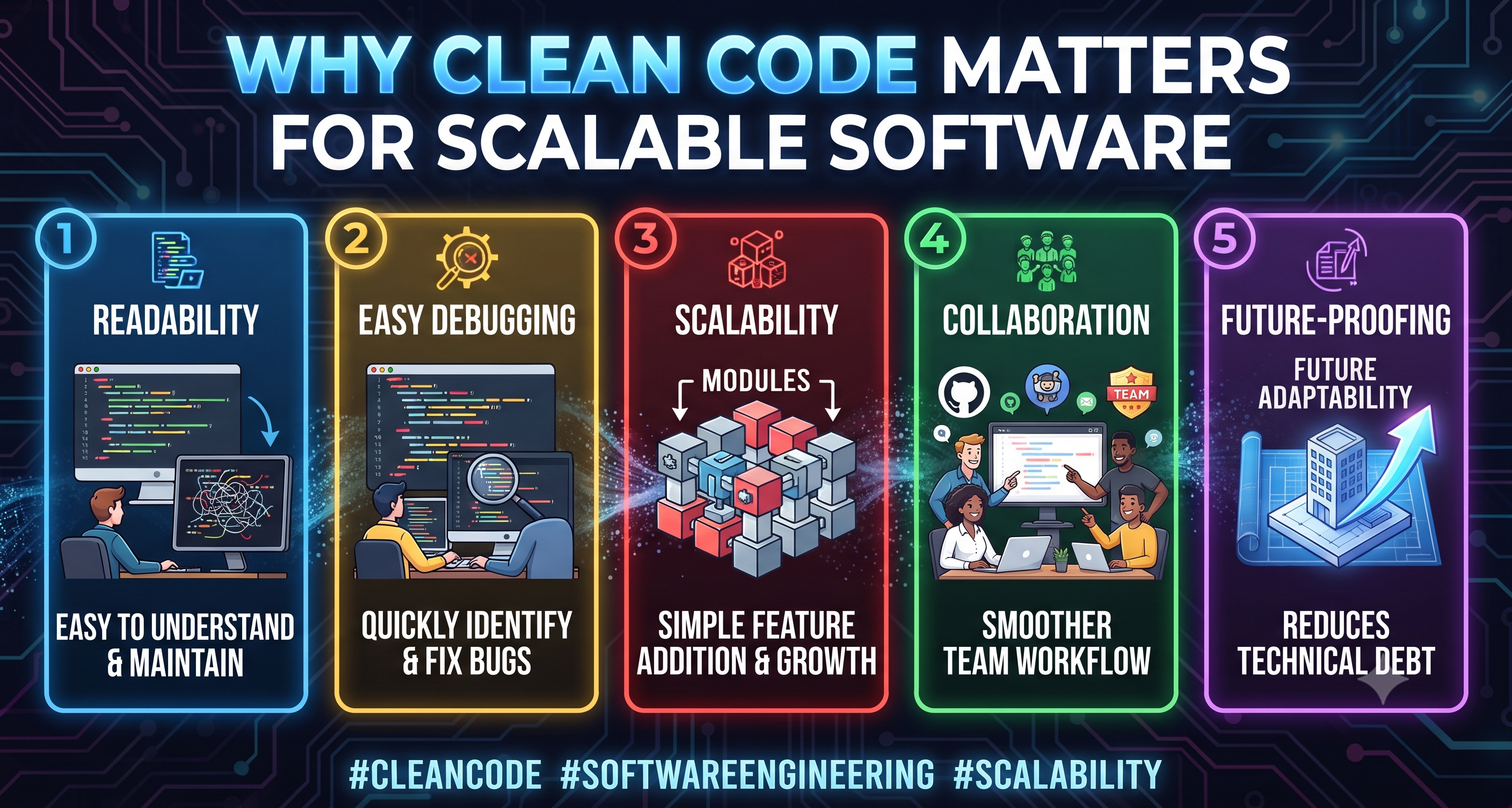
Readability: Anyone on the team can understand what the code does without spending hours deciphering convoluted logic.
Simplicity: It avoids clever tricks and over-engineering, solving problems in the most straightforward way possible.
Testability: It is written in modular components that can be easily unit-tested and verified.
Maintainability: It can be updated, refactored, or extended with minimal risk of breaking existing functionality.
The Illusion of Speed: Technical Debt vs. Clean Code
A common misconception in software engineering is that writing clean code slows you down. Teams often argue, "We don’t have time to refactor; we need to ship!"
However, this creates a dangerous illusion of speed. Writing messy code might save you a few hours today, but it will cost you weeks, months, or even years down the line.
The Messy Code Trajectory: As time goes on, the velocity of the development team plummets. What used to take a day now takes a week because developers must spend 80% of their time reading, untangling, and debugging legacy code just to add a small feature.
The Clean Code Trajectory: While initial development might take a fraction longer, velocity remains steady or even increases over time. Because the codebase is modular and easy to understand, new features can be integrated seamlessly.
Why Clean Code is the Foundation of Scalability
Scalability is rarely just about adding more servers or optimizing database queries. True software scalability encompasses two critical dimensions: system scalability (handling increased traffic and data loads) and team scalability (growing the engineering organization without slowing down). Clean code is vital for both.
1. Facilitating Seamless Team Growth
When a product scales, the engineering team inevitably grows. New developers are hired, contractors are brought in, and organizational structures shift.
In a messy codebase, onboarding a new developer can take months. They must navigate undocumented dependencies, spaghetti code, and fragile functions. Every time they touch a piece of code, something else breaks.
Conversely, clean code acts as its own documentation. Meaningful naming conventions, small functions, and clear separation of concerns allow a new engineer to understand the architecture rapidly and contribute safely within days, rather than months.
2. Reducing Bugs and Simplifying Debugging
As applications scale, the surface area for bugs expands exponentially. In a poorly structured codebase, tracking down the root cause of a production failure is like looking for a needle in a haystack. Side effects ripple invisibly across tightly coupled modules.
Clean code enforces modularity and single-responsibility principles. If a bug occurs, it is isolated to a specific, well-defined component. This makes debugging faster, automated testing more reliable, and production outages significantly less frequent.
3. Making Refactoring and Optimization Possible
Scalability requires continuous evolution. As user volume grows, bottlenecks emerge—perhaps a specific algorithm is too slow, or a data pipeline needs to be redesigned for distributed processing.
Refactoring a messy codebase is terrifying. Developers often avoid optimizing performance because touching one fragile block of code threatens to collapse the entire application. Clean code, backed by robust automated tests, makes refactoring safe and frictionless. You can rewrite or optimize underlying implementations with confidence, knowing that the system's contract remains intact.
4. Protecting Business Agility and ROI
Software is a living asset. If your code is unmaintainable, your business loses its agility. When market demands shift and you need to pivot your product strategy, a bloated codebase will paralyze your engineering team.
Clean code ensures that your software remains flexible. It protects your return on investment (ROI) by ensuring that the application can evolve alongside business goals without requiring costly, ground-up rewrites every few years.
Best Practices for Writing and Maintaining Clean Code
Achieving and sustaining a clean codebase requires discipline, culture, and continuous effort. Here are foundational practices every engineering team should adopt:
Follow SOLID Principles: Master object-oriented design principles (Single Responsibility, Open/Closed, Liskov Substitution, Interface Segregation, Dependency Inversion) to keep your architecture decoupled.
Practice Code Reviews: Make peer reviews a mandatory part of your workflow. Fresh eyes help catch complexity, enforce standards, and share architectural knowledge across the team.
Automate Testing: Write unit, integration, and end-to-end tests. Clean code is testable code, and comprehensive test suites give you the safety net needed to refactor fearlessly.
Refactor Continuously: Adopt the "Boy Scout Rule"—always leave the campground cleaner than you found it. Whenever you touch a piece of code, improve its readability or structure slightly.
Establish Clear Coding Standards: Agree on a team-wide style guide and leverage automated linters and formatters (like ESLint, Prettier, or Black) to eliminate subjective stylistic debates.
Conclusion
In the world of software development, shortcuts are rarely shortcuts—they are detours that lead straight into technical debt.
Scaling a software product successfully requires more than just powerful cloud infrastructure and clever algorithms; it requires a disciplined commitment to clean code. By prioritizing readability, maintainability, and simplicity, engineering teams can build resilient systems that scale gracefully, onboard new talent effortlessly, and adapt to the ever-changing demands of the market.
Invest in your code today, and your future self—and your scaling business—will thank you.