
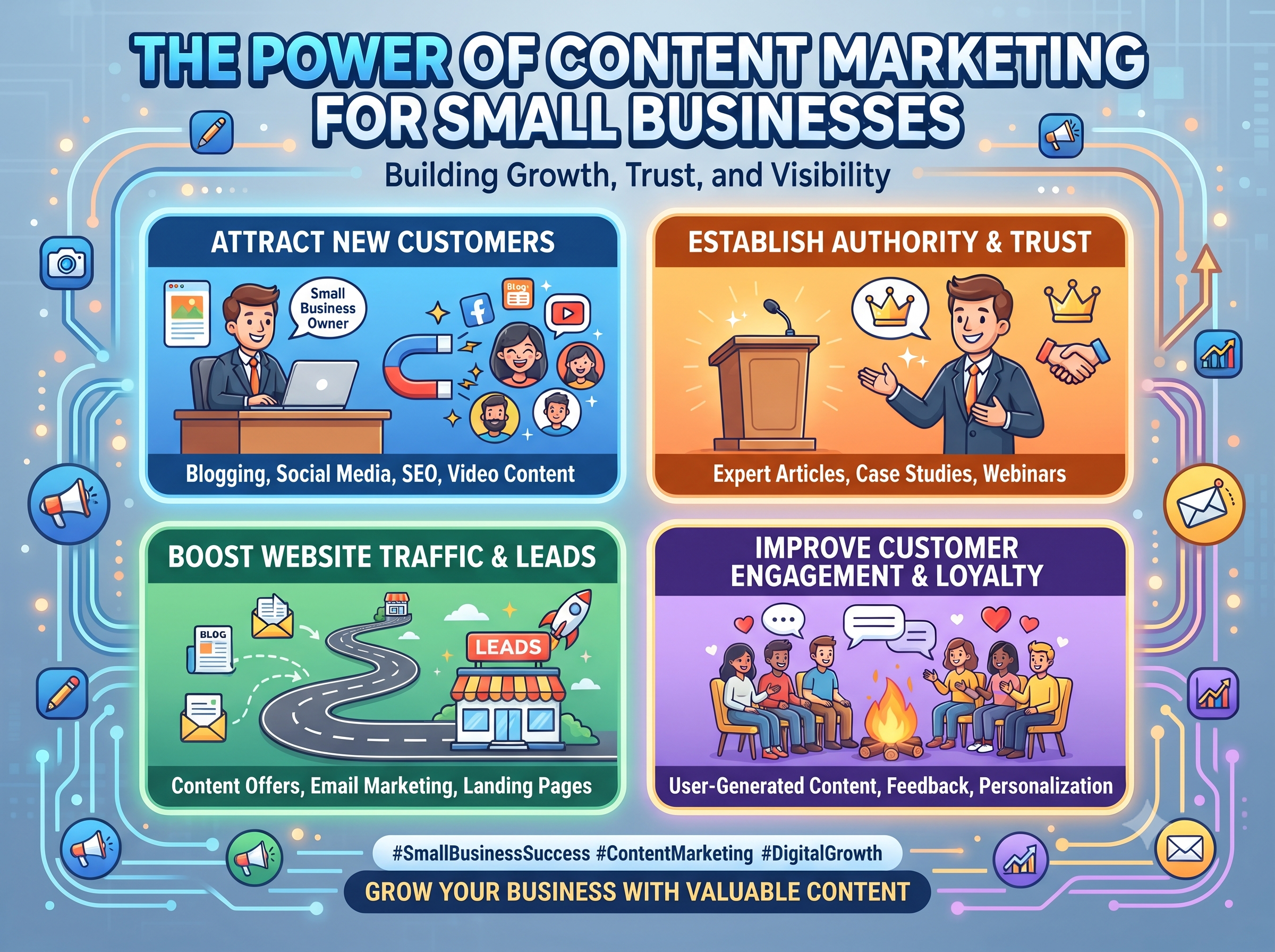
For small business owners, competing against enterprise giants with multi-million dollar advertising budgets can feel like David fighting Goliath. When you allocate funds to pay-per-click (PPC) ads or social media promotions, every dollar counts. The moment your campaign budget runs dry, your traffic dries up right along with it.
Enter content marketing.
Unlike traditional advertising that interrupts potential customers with sales pitches, content marketing focuses on delivering genuine, educational, and entertaining value. It is a long-term strategy built on trust, authority, and organic reach. For small businesses operating with lean teams and tight budgets, content marketing isn't just an alternative marketing tactic—it is often the most cost-effective engine for sustainable growth.
Let’s explore why content marketing is so powerful for small businesses and how you can harness it to build a loyal customer base.
What is Content Marketing and Why Does It Matter?
At its core, content marketing involves creating and sharing relevant blog posts, articles, videos, infographics, podcasts, and social media content designed to attract, engage, and retain a clearly defined audience.
Instead of shouting "Buy my product!" content marketing whispers, "Here is how to solve your problem, and by the way, we have a tool that can help."
The Small Business Advantage
While large corporations are weighed down by red tape, corporate bureaucracy, and sterile marketing language, small businesses have a superpower: authenticity and agility.
As a small business owner, you possess deep, specialized knowledge of your niche and your customers' pain points. Content marketing gives you a platform to showcase that expertise, allowing you to connect with your target market on a deeply human level.
1. Cost-Effective Lead Generation and Long-Term ROI
For a small business, cash flow is everything. Traditional advertising requires continuous financial injection. If you spend 1,000 dollars on ads this month, you get traffic this month. Next month, you have to spend another 1,000 dollars.
Content marketing operates differently. It is an investment that compounds over time.
The Evergreen Effect: A well-researched, SEO-optimized blog post or resource guide published today can continue generating organic search traffic, leads, and sales for months—or even years—to come.
Lower Cost Per Acquisition (CPA): Studies consistently show that content marketing generates significantly more leads at a fraction of the cost of outbound marketing. Once a piece of content is live, the marginal cost of a new reader finding it is near zero.
2. Building Trust and Authority in Your Niche
People buy from brands they know, like, and trust. In crowded modern markets, trust is the ultimate currency.
When a prospective customer encounters your business for the first time, they are naturally skeptical. However, if they find a series of in-depth blog posts on your website that answer their most difficult questions, explain industry concepts clearly, and guide them toward smart decisions without a hard sales push, that skepticism melts away.
Establishing Thought Leadership: By generously sharing your knowledge, you position your small business as an authority in your field.
Shortening the Sales Cycle: When a reader consumes your helpful content over time, they enter your sales funnel pre-educated and pre-qualified. By the time they reach out for a consultation or add a product to their cart, the trust barrier has already been broken.
3. Fueling SEO and Driving Organic Web Traffic
Content and SEO are two sides of the same coin. Search engines like Google crawl the web looking for fresh, authoritative, and helpful content to serve users searching for answers. Every piece of content you publish is a new indexed page—a new digital doorway leading people straight to your website.
Targeting the Entire Buyer's Journey: Content marketing allows you to capture traffic at different stages of intent:
Top-of-funnel (Informational): Blog posts answering broad questions ("How to choose a CRM").
Middle-of-funnel (Evaluation): Comparison guides ("Tool A vs. Tool B").
Bottom-of-funnel (Decision): Case studies and product breakdown guides.
Attracting Backlinks: High-quality, original content serves as a magnet for backlinks. When other websites in your industry cite your data, research, or guides, your domain authority skyrockets, lifting your overall search rankings.
4. Cultivating Community and Brand Loyalty
Marketing shouldn't stop at the point of sale. Retaining customers and turning them into brand advocates is vital for small business longevity.
Content marketing nurtures your existing customer base long after they have made a purchase. Through regular newsletters, tutorial videos, community forums, and educational deep-dives, you help your customers get maximum value out of what they bought from you.
Reducing Churn: Customers who understand how to use your product effectively are far less likely to cancel subscriptions, return items, or churn to a competitor.
Word-of-Mouth Advocacy: Delighted customers who feel educated and supported by your content naturally become vocal advocates, recommending your business to their friends, colleagues, and social networks.
Practical Steps to Launching a Small Business Content Strategy
You don't need a massive marketing department to succeed with content marketing. You just need consistency, focus, and a strategic framework:
Define Your Audience: Understand who your ideal customer is, what keeps them awake at night, and what questions they are typing into search engines.
Focus on Quality Over Quantity: Publishing one exceptional, highly useful article a week is far more effective than publishing five rushed, thin posts that no one wants to read.
Repurpose Your Content: Turn a single blog post into an email newsletter, a series of social media graphics, a short video script, or a downloadable checklist to maximize your reach.
Be Consistent: Content marketing is a marathon, not a sprint. Stick to a realistic publishing schedule and give your strategy time to gain traction in search engines.
Conclusion
For small businesses, content marketing is the great equalizer. It does not require a massive ad budget; it requires insight, creativity, and a genuine desire to help your audience succeed.
By consistently creating valuable, educational, and search-optimized content, you build an enduring digital asset that attracts organic traffic, establishes unbreakable trust, and drives sustainable revenue. Start sharing your expertise today, and watch your small business grow from the ground up.